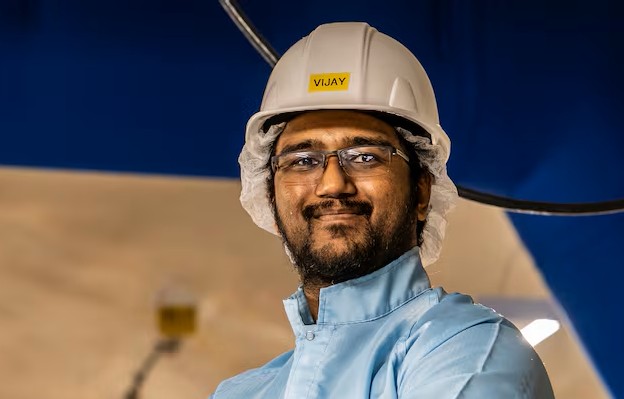
Dr. Vijay Iyer
Research Scientist
Dr. Vijay Iyer was born and raised in Mumbai, India, where he completed his formative education. He earned his Ph.D. in astroparticle physics from the National Institute of Science Education and Research (NISER), India. His doctoral thesis focused on characterizing and calibrating direct dark matter search detectors, which served as his introduction to the specialized world of low-temperature semiconductor physics and cryogenics. Following his Ph.D., Vijay completed postdoctoral fellowships at the University of Toronto and the Institute for Quantum Computing (IQC) at the University of Waterloo.
During his tenure at the University of Toronto, Vijay became a critical member of the SuperCDMS collaboration, playing a lead role in its installation at SNOLAB. His contributions ranged from detector installation & testing to the setup of radiation shielding. He also spearheaded upgrades to SNOLAB’s Cryogenic Underground TEst (CUTE) facility, where he oversaw the implementation of calibration systems and supported the development of slow-control infrastructure. At IQC, his research pivoted toward advancing superconducting qubits, specifically developing methodologies to mitigate correlated errors and studying the impact of radiation on qubit coherence. At SNOLAB, his primary mission is to cultivate a robust quantum science initiative, with an ambition of positioning Sudbury as a premier global destination for cutting-edge quantum experiments.
Vijay is deeply committed to education, mentorship, and science advocacy. He has guided numerous undergraduate and master’s students and previously served as the Education and Outreach Head for the SuperCDMS experiment. His leadership extends to the international stage; he represented India at the APS International Youth Leadership Forum and collaborated with the Indian Physics Association (IPA) to establish a Young Leaders Forum to address systemic bottlenecks in academia. A dedicated science communicator, Vijay is also a registered volunteer with a Canadian charitable organization called Let’s Talk Science, which enables him to visit schools to inspire the next generation of STEM professionals.
Outside of the lab, Vijay is a fixture in the local community. You are most likely to find him at the cinema, on a cricket or softball field, or at a local cafe. He is also a regular in the Sudbury dance scene, having explored everything from Argentine Tango and Waltz to Salsa, Swing, and Irish set dancing. He remains a passionate advocate for community development and local engagement.
How would you describe your work in simple terms?
At its core, my work is about understanding the universe at its most fundamental level—essentially, I’m a detective for things you can’t actually see. I study the elementary building blocks of our reality, from the ‘celebrity’ particles like electrons to the more introverted mysteries like dark matter. Using various experimental probes, I help unravel the underlying rulebook of physics—figuring out exactly when to apply the grounded logic of classical mechanics versus the ‘spooky’ actions of quantum science. At SNOLAB, I focus on turning these deep-space and material secrets into quantum technologies that will meaningfully benefit society. It’s a bit like trying to read the universe’s source code, one tiny bit at a time.
What does a typical day at SNOLAB look like for you?
SNOLAB is a uniquely bizarre place to work, so a ‘typical’ day usually falls into one of two extremes. Some days, I’m glued to my office chair, diving deep into data analysis, deciphering equipment manuals, and attending meetings—essentially a standard desk job, just with cooler graphs. On other days, my commute involves traveling 2 km straight down into the Earth to our underground clean lab to set up and run experiments. Those are my ‘field days,’ and they are much more physically demanding. Both types of days are incredibly satisfying, though only one requires a hard hat. And more often than I’d like to admit, a typical day involves getting well and truly dumbfounded—though I’ve made it a personal rule to never make the same mistake twice.
Why did you choose physics?
I’ve been fascinated by astronomy and astrophysics ever since I was a kid. Call me ambitious, but seeing how society looks up to scientists—and expects them to casually go out and change the world—definitely shaped my decision to pursue a doctorate and become one. After all, who doesn’t want to be a hero?
What is something in your career you are especially proud of?
Since I work in quantum science, I will answer this as a superposition of states:

The answer keeps on changing depending on how and when you ask me this question.
What is something about you that might surprise people?
People often assume being a scientist is just sitting at a blackboard solving equations. But as an experimentalist at SNOLAB, my job is a lot more hands-on. To safely set up my experiments underground, I’ve had to get certified in operating cranes, rigging heavy loads, working at heights, navigating confined spaces, and driving mobile lift platforms. So, if this whole ‘physics’ thing doesn’t pan out, I am fully qualified to clean windows on high-rises, move industrial equipment out of your way, or rescue a cat from a really, really tall tree.