SNOLAB officially becomes one of the coolest places on Earth
March 17, 2026
— Astrophysics News
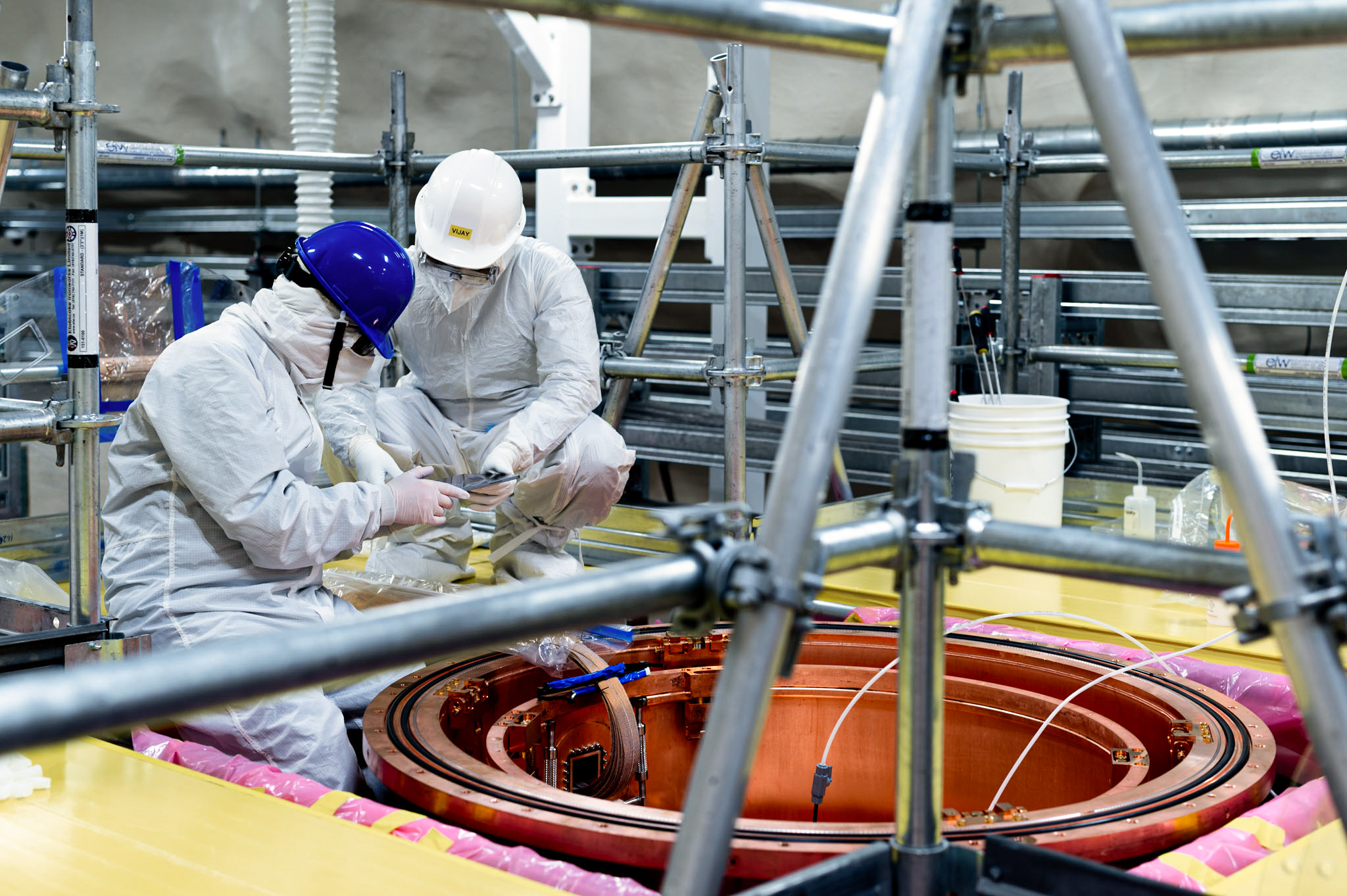
Deep underground in Sudbury’s SNOLAB, a major new experiment has just reached a critical milestone. The very centre of a series of large, nested copper vessels that make up the heart of the newest and one of the most sensitive detectors in the world has now reached a temperature a hundred times colder than outer space.
After several years of fabricating and installing, a team of international scientists and SNOLAB staff working on the Super Cryogenic Dark Matter Search (SuperCDMS) experiment have successfully cooled the experiment to its base temperature — just tens of millikelvin, or a hundredth of a degree above absolute zero.
Reaching base temperature marks a major transition for SuperCDMS, from construction and installation to commissioning and science operations. The SuperCDMS experiment is poised to join the international search for dark matter, the elusive sub-atomic particle thought to comprise up to 85 per cent of the mass of the universe.
Photo Album: SuperCDMS SNOLAB – Construction to Installation | Flickr
We know from astrophysical observations that our solar system and Milky Way galaxy sit inside a halo of dark matter, and that dark matter is passing through us all the time. The challenge is to build a detector quiet enough and sensitive enough to observe the very rare interactions of dark matter particles.
At the heart of SuperCDMS are 24 cryogenically cooled detectors made from ultra-pure silicon and germanium crystals, each just larger than a hockey puck. When a dark matter particle strikes one of these crystals, it produces a tiny vibration called a phonon, along with a small electrical signal. To detect those minuscule signals, the crystals are outfitted with superconducting sensors that only work when they are extremely cold.
SuperCDMS is optimized to explore a region of dark matter models that has remained largely uncharted: light dark matter, a hypothesized form of matter that interacts so weakly with ordinary matter that it has so far escaped direct detection, says Miriam Diamond, assistant professor in the Department of Physics and the Department of Astronomy & Astrophysics, University of Toronto and a SuperCDMS collaborator.
“What sets SuperCDMS apart from other dark matter searches is its low threshold for detecting tiny energy depositions,” Diamond says. “This gives it exquisite sensitivity to low-mass dark matter candidates, including WIMP-like particles, axion-like particles, dark photons, and lightly-ionizing particles.”
Reaching base temperature is the culmination of years of preparation and months of detailed planning. Over the last year, the team developed a step-by-step cooldown plan, working closely with cryogenics experts responsible for different parts of the system.
“The detectors simply don’t function unless they’re cold enough to enter the superconducting transition,” said SLAC scientist Richard Partridge, who manages the experiment’s installation. “For us, that means roughly 15 to 30 millikelvin.”
Cooling the experiment reduces thermal noise, the random motion of atoms that can mask faint signals.
“When everything is that cold, the crystals are basically quiet,” Partridge said. “Even very small energy deposits become detectable.”
Building an experiment underground is always a unique experience, especially one that is on the scale of SuperCDMS, says SNOLAB research scientist Matt Stukel. There have been countless checks: mechanical, thermal, vacuum integrity; and for the most part things have gone remarkably smoothly.
“Plans that work on surface don’t always translate when you get to the underground facility. Luckily SuperCDMS is an incredibly talented collaboration, filled with innovative thinkers who can rapidly come up with solutions,” said Stukel. “I’m excited that we reached base temperature, but more excited for the future science that we will do.”
With base temperature achieved, the collaboration will move into detector commissioning, a months-long process of turning on, calibrating and optimizing each detector channel.
Once commissioning is complete, SuperCDMS will begin its first science run, expected to last about a year. Even the first few months of data could be enough to set world-leading limits on light dark matter or reveal something entirely new.
Beyond dark matter, SuperCDMS will allow scientists to probe previously inaccessible energy scales thanks to its unprecedented sensitivity, and maybe even uncover entirely new kinds of particle interactions.
The SuperCDMS SNOLAB experiment is a joint project of the U.S. Department of Energy Office of Science, the U.S. National Science Foundation, the Canada Foundation for Innovation, the Natural Sciences and Engineering Research Council of Canada, and the Arthur B. McDonald Institute (Canada).
-30-
About SNOLAB:
SNOLAB is Canada’s deep-underground science laboratory, located at a depth of 2 kilometres in Vale’s Creighton Mine near Sudbury, Ontario. Using the Canadian Shield to protect experiments from the cosmic rays that constantly bombard the Earth’s surface, SNOLAB supports world-class astroparticle physics research and has attracted innovative life science and quantum technology programs.
By hosting and enabling the world’s most advanced and sensitive underground experiments, SNOLAB bolsters Canada’s scientific reputation, attracts new talent to our country and Northern Ontario, trains more highly skilled people, provides more opportunities for Canadian researchers to lead international projects, and generates economic benefits for Ontarians and Canadians.
About SLAC:
SLAC National Accelerator Laboratory explores how the universe works at the biggest, smallest and fastest scales and invents powerful tools used by researchers around the globe. As world leaders in ultrafast science and bold explorers of the physics of the universe, we forge new ground in understanding our origins and building a healthier and more sustainable future. Our discovery and innovation help develop new materials and chemical processes and open unprecedented views of the cosmos and life’s most delicate machinery. Building on more than 60 years of visionary research, we help shape the future by advancing areas such as quantum technology, scientific computing and the development of next-generation accelerators.
SLAC is operated by Stanford University for the U.S. Department of Energy’s Office of Science. The Office of Science is the single largest supporter of basic research in the physical sciences in the United States and is working to address some of the most pressing challenges of our time.
For More Information:
Mike Whitehouse
Senior Communications Officer | SNOLAB
MWhitehouse@SNOLAB.ca
(705) 690-5270