SNOLAB is located on the traditional territory of the Robinson-Huron Treaty of 1850, shared by the Indigenous people of the surrounding Atikameksheng Anishnawbek First Nation as part of the larger Anishinabek Nation.
We acknowledge those who came before us and honour those who are the caretakers of this land and the waters.
SNOLAB is Canada’s award-winning, deep-underground research laboratory
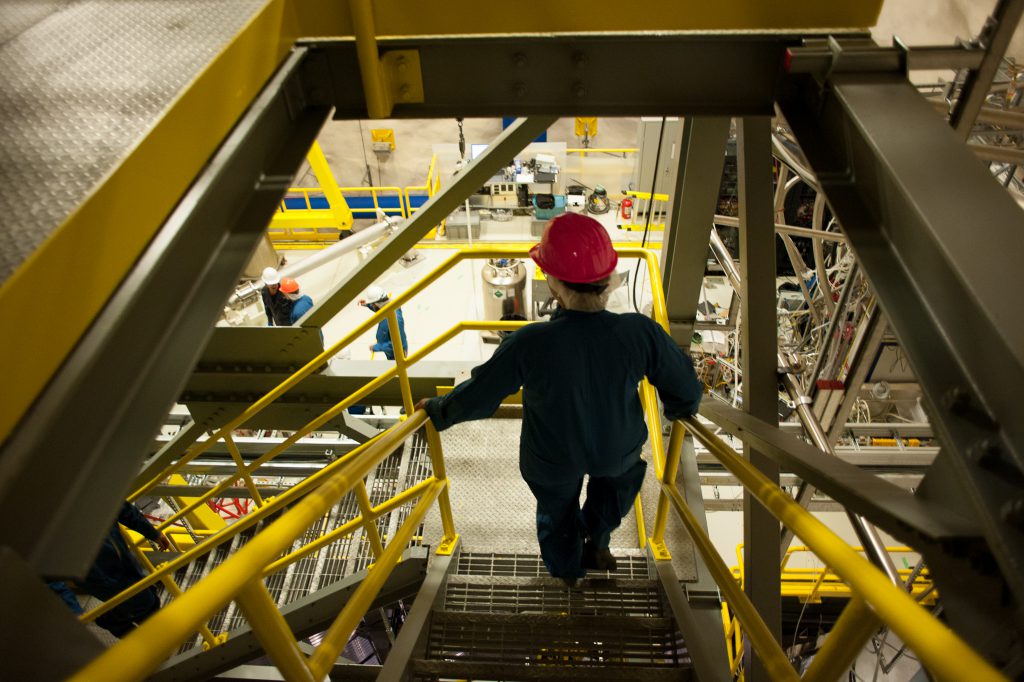
Located at a depth of 2 kilometres in Vale’s Creighton Mine near Sudbury, Ontario, SNOLAB uses the Canadian Shield to protect experiments from the cosmic rays that constantly bombard the Earth’s surface. SNOLAB supports world-class and diverse astroparticle physics research program and has grown to attract innovative life science and quantum technology programs.
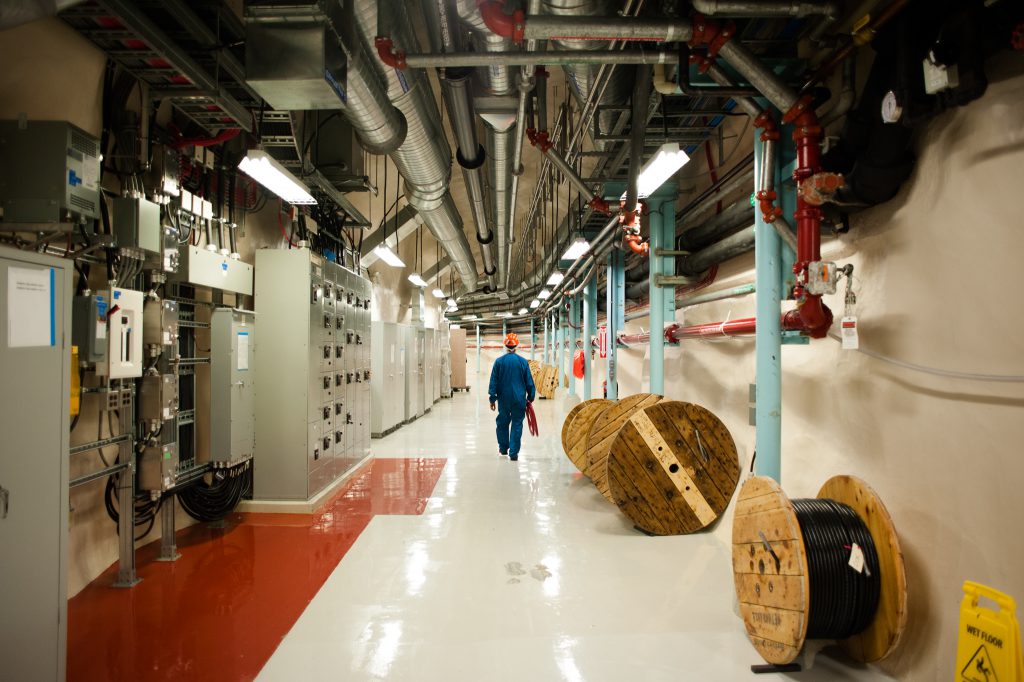
SNOLAB is an expansion of the facilities constructed for the Nobel Prize-winning Sudbury Neutrino Observatory (SNO) solar neutrino experiment and has 5,000 m2 of clean space underground for experiments and supporting infrastructure. A highly qualified staff of 150 support the science, providing business processes, engineering design, construction, installation, and technical and operational support. SNOLAB research scientists provide expert and local support to the experiments as contributing members of experimental collaborations.
By hosting and enabling the world’s most advanced and sensitive underground experiments, SNOLAB bolsters Canada’s scientific reputation, attracts new talent to our country and Northern Ontario, trains more highly skilled people, provides more opportunities for Canadian researchers to lead international projects, and generates economic benefits for Ontarians and Canadians.
History of SNOLAB
From 1970 to 1994, there was another underground neutrino detector set up in a mine in South Dakota. The Homestake experiment, a brainchild of Dr. Ray Davis, was set up to measure neutrinos from the Sun. But data collected there presented a problem: the detector measured only about a third the number of neutrinos predicted by theorists. The experiment appeared to be sound, so what was going on? Physicists were concerned there may be fundamental flaws in the Standard Model, something wrong with our entire understanding of physics. There was even a possibility the diminished neutrino output was a sign that the Sun was actually going out (because of electromagnetic interactions light takes much longer to escape the Sun than neutrinos, so this was a valid concern).
The SNO experiment was designed to address this question, dubbed by physicists ‘The Solar Neutrino Problem.’ Scientists knew that neutrinos came in three flavours: electron, muon, and tau. Up until this point, it was assumed that they did not change flavour. The Homestake experiment was sensitive only to electron neutrinos, the flavour produced in the Sun. SNO was designed to be sensitive to all three flavours of neutrino. Years of data from the SNO experiment found that in fact the Sun was creating the expected number of neutrinos, but they were changing flavour on their journey to Earth, so the Homestake experiment missed some of them. This finding was corroborated by the Super-Kamiokande detector in Japan, and the 2015 Nobel Prize in physics was awarded to Dr. Art McDonald of SNO and Dr. Takaki Kajita of Super-K.
The success of SNO and a strong working relationship with Inco (later Vale) meant plans to expand the lab were already in the works as SNO was still collecting data. The SNOLAB expansion added an additional 6,300 m2 of excavations, of which 3,700 m2 is clean room space, attached to the existing facility. The clean/dirty boundary was moved for the expanded laboratory and some existing excavations were converted to additional clean space.
Over the last decade, SNOLAB has evolved from a single-experiment site to an internationally recognized multi-experiment facility. Our success in particle physics and unique low-radioactivity environment have attracted new experiments in dark matter searches, life sciences, nuclear security, and quantum technology.
SNOLAB offers expert scientific, technical, and administrative support to more than 1,000 users and collaborators from 165 institutions in 23 countries around the world. SNOLAB is the only underground facility where all full-time staff are dedicated to performing and supporting research, from design to decommissioning. Our partner, Vale, maintains and provides access to the mine. This focus on science and expertise makes SNOLAB the global location of choice for deep underground science and an important training ground in Canada for highly qualified personnel (HQP) in underground science and technologies.